
Rethinking Second Life onboarding - from technical entry to gradual social integration

One of the long-standing challenges of Second Life is not the technology itself, but the retention of new users. While the platform’s freedom, creativity, and social possibilities remain unique, the first experience is often too fast and too unstructured for newcomers.
The current onboarding model is primarily based on technical learning. New users are introduced to basic functions such as movement, flying, teleporting, and interface usage, and then quickly placed into the full open world. This works on a functional level, but it does not prepare users for navigating a complex social virtual environment.
The issue is not that users cannot move or teleport. The issue is that they do not yet understand how the world works.
The problem of freedom and an open world
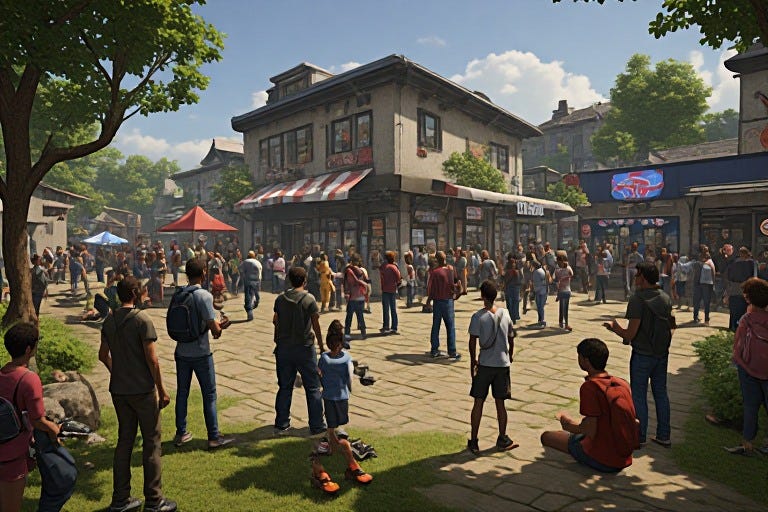
One of Second Life’s greatest strengths has always been its full freedom. However, for a new user, this freedom often arrives too suddenly and in too large a scale.
Modern digital environments are typically highly structured. Users are continuously guided, directed, and recommended actions or content. In contrast, Second Life is an open world where everything depends on the user’s own decisions and curiosity.
This is not inherently a problem, but for newcomers it can easily lead to uncertainty or a sense of being lost.
This becomes especially visible in areas such as the Adult Welcome Hub. New users arrive in an environment whose social, cultural, and functional rules they do not yet understand. They often lack appropriate avatars, do not know the communication norms, and are not familiar with the technical systems or interaction possibilities, which makes it difficult for them to actually use the space.
In many cases, users are technically allowed into the environment, but are not yet prepared to participate in it meaningfully.
Users may also enter these areas out of curiosity, trying to understand how adult interactions, avatar relationships, and the broader adult system work. However, they often lack even the basic understanding of avatar usage, animation systems, and social context required to interpret these interactions.
While Adult Hub mentors provide important support, it cannot realistically be expected from them to demonstrate or personally guide users through intimate or adult-oriented interactions. This is partly due to regulatory constraints and partly due to personal boundaries, both of which are entirely understandable.
As a result, new users may enter adult environments without the necessary context, making the experience confusing rather than educational or engaging.
A multi-stage onboarding model
This situation suggests the need for a multi-stage onboarding system that provides transitional learning and social spaces for new users.
The core idea is not isolation, but gradual integration. New users would begin in smaller groups within structured onboarding environments where everyone is at a similar experience level.
In these spaces, users would:
learn basic technical skills,
explore avatar customization,
understand inventory and shopping systems,
learn basic social mechanics of the platform,
and gradually build connections with other new users.
The focus would not be purely educational, but also experiential and social.
Community formation from the beginning
In the current system, many new users struggle to integrate into existing communities. Established communities naturally have their own norms, culture, and long-standing relationships, which can make them difficult to approach for newcomers.
A smaller onboarding group structure would allow users to build social connections from the very beginning. These groups would function as micro-communities formed during the learning phase itself.
These micro-communities could later:
expand organically,
connect with larger existing communities,
or evolve into independent social groups.
This process would strengthen long-term engagement and social stability within the platform.
Skill-based progression and gradual access
The system could also include a basic skill or competency model, not as a game-like leveling system, but as a structured way to measure platform literacy.
Users would gradually gain experience in areas such as:
communication,
avatar control,
clothing and customization,
shopping and inventory management,
social interaction,
creative and building tools.
The goal would not be restriction, but ensuring that users reach a sufficient level of competence before entering the fully open and complex parts of the world.
Evolving the role of mentors
The existing SL mentor system already plays an important role in onboarding. However, its function could be expanded.
Mentors would not only provide technical assistance, but also play a stronger role in social integration. The focus would shift toward helping users understand how the world functions socially, not just technically.
This would create a more human-centered onboarding experience.
A more human-centered onboarding model
The goal of this proposal is not to restrict users, but to design an onboarding process that is more gradual, more social, and more experience-driven.
Second Life is not only a technical platform, but a virtual social environment. Therefore, onboarding should not be limited to technical instruction, but should also support how users become active and independent participants in the world.